I. Foreword: The Final Swansong of an Ultra-Value Cabin
China Airlines (CI) began utilizing the Airbus A350-900 for its Vancouver-Taipei route starting in August 2017, marking the end of CI’s Boeing 747 era for long-haul intercontinental flights. This transition also signaled the conclusion of a period offering an exceptionally high-value, hidden Premium Economy (PE) product.

Prior to this, CI removed First Class from its international routes starting in 2015, adjusting its three-cabin configuration (First-Business-Economy) to a new setup (Business-PE-Economy). While the newly introduced 777-300ER and A350-900 were fitted with modern seating, its existing 747-400 fleet adopted a simpler retrofit: the original First Class became Business Class, and the original Business Class was downgraded and sold as Premium Economy.
This arrangement inadvertently created one of the world’s best-value PE products. Passengers could pay the PE fare while enjoying international Business Class standard wide seating, unparalleled legroom, and the distinct experience of the Boeing 747 upper deck. Therefore, I made several trips on CI’s 747 PE, routing from Vancouver to Taipei and connecting onward to other Asian destinations, before the A350 took over.
Last February, my first CI flight was booked using an American Express Platinum Card. Thanks to the annual travel credit, the round-trip ticket cost me only 1,400 CAD out-of-pocket. When booking, the Amex agent helped me secure the coveted window seat 10A on the 747’s upper deck.
II. Airport Transit and Check-in: A Study in Contradiction
My CI check-in experience at Vancouver Airport (YVR) was, frankly, unpleasant. The counter staff rigorously weighed my carry-on bag, and upon finding it to be 13kg—significantly over the 7kg limit—they insisted I check the bag. This unexpected and strict approach to hand luggage became a recurring theme in my subsequent YVR check-ins with CI. Ironically, upon arrival in Taipei for my transfer, no one questioned the same bag’s weight, allowing me to convert it back from checked luggage to carry-on.
(Prior to the opening of the SkyTeam alliance lounge at YVR) Due to the high volume of airlines using the Plaza Premium Lounge, the experience was mediocre, and it is not detailed here.
III. Boarding and Welcome: Elite Privileges
CI set up three boarding zones: Priority One (Business Class/SkyTeam Super Elite travelers), Zone Two (Premium Economy), and the final zone (Economy). Thanks to my alliance super-elite frequent flyer status, I bypassed the PE zone and received Priority One boarding.
IV. Cabin Facilities and Experience: The Jumbo Jet Legacy
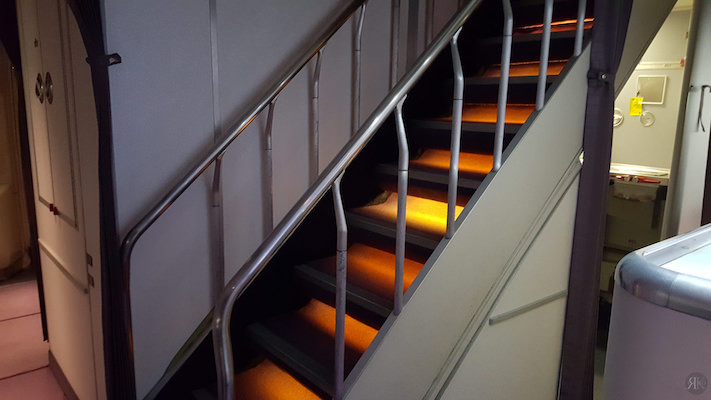
Entering the Boeing 747 cabin, the most impressive features were its vast spaciousness and, of course, the distinctive staircase leading to the upper deck.

Arriving upstairs, the space felt more contained, almost like transitioning from a wide-body to a narrow-body aircraft. However, the 747’s entire second floor was dedicated to Premium Economy (using the former Business Class seats), featuring a comfortable 2-2 layout with 6 rows (24 seats total). The newer generation seats on this flight were well-maintained and did not look dated. (It’s worth noting that CI utilized a confusing mix of new and old seats across the 747 fleet).


The seat itself, at first glance, led me to believe it was a 180-degree fully flat bed, though the maximum recline was 160 degrees. Even so, for a Premium Economy product, this still represented one of the most luxurious seat configurations available. A classic 747 hallmark is the large storage bin next to the window seat. Its capacity was so generous that it could easily accommodate the very carry-on bag I was forced to check downstairs. As the Boeing 747 and Airbus A380 are gradually retired, this kind of aerial storage space will become a thing of the past.

CI PE cabin also provided passengers with slippers and an amenity kit. The slippers were of Business Class quality, though subsequent CI PE flights after late 2017 featured the inferior Economy Class slippers. Thanks to the intimate layout of only six rows, the overall hardware experience strongly suggested a level far above standard Premium Economy.


V. In-Flight Dining and Service: The High Point of Hospitality
Upon boarding, two flight attendants at the cabin entrance greeted me with natural smiles and directed me upstairs. Once on the upper deck, two more attendants offered equally friendly greetings and showed me to my seat.
Shortly after boarding, the Cabin Service Manager made a special visit to my seat to personally greet me, thank me for flying with CI as a SkyTeam Elite Plus member, and inquire about any needs I might have. China Airlines’ service attitude toward elite members of external SkyTeam airlines was the best I have ever encountered. Their smiles felt genuine, and their service was professional yet warm (不卑不亢), making the interaction comfortable and respectful.
The Vancouver-Taipei route is a red-eye flight, but a dinner service was still provided, followed by breakfast two hours before landing, with menus distributed beforehand. The illusion of Business Class service lasted until the meal tray arrived—as expected, the catering was kept strictly to the Premium Economy standard. Following dinner, a small cup of ice cream was offered. After the service concluded, the cabin lights dimmed, and I adjusted my 160-degree seat for sleep, managing a solid six hours of rest.

VI. Post-Flight Reflection and Conclusion
This experience thoroughly spoiled me with the 747 PE product. Aside from the meal quality, the seat hardware, legroom, and privacy were nearly indistinguishable from a true Business Class offering. In fact, CI continues to use this seat as regional Business Class on shorter Asian routes.
It is truly unfortunate that CI has retired the 747 from intercontinental service. My lasting impression from multiple CI flights is their superior service quality. The attendants’ smiles are sincere, unlike the forced cordiality on some other airlines. Furthermore, their proactive greetings and special attention given to external alliance elite members are particularly memorable. As a Delta frequent flyer, I would certainly prioritize China Airlines if the mileage accrual rates on North America-Asia routes were more favorable.